

Education is fun and memorable with hands-on flying! Here are a few ideas on what can be learned from making Squirrels.
Squirrel inspires youth and adults to ponder physics, math and nature in classrooms all over the world.
Teachers get a chance to slow down and let the kids spend some quality hands-on time with making a real flying machine.
Materials for Model Plane Project:
All you need is glue and scissors if you purchase kits.
Any craft glue should work. Aleene’s Tacky glue is a known brand that works well. One bottle of glue is good for a classroom (see section on glue sharing in the environment page). White glue or carpenter glue should be fine but may need a longer dry time.

You’ll also want generic glue sticks and scissors. You don’t need to have one for each child. A glue stick for every two or three people and scissors for every two or three should be okay.
If you can’t afford kits you can make your own Squirrel parts (or send a note explaining the situation). We suggest that you do all cutting of parts in advance as you may not want kids get injured. The downloadable instructions have a bill of materials.
Education

Measurement
It is fun to have an objective and measurement. A duration contest is one fun way to inspire constructive competition and learning. It is easy to time how long a plane flies from launch till it lands or stops flying. A leader board can be made and students can reflect on what factors bear on flight duration. There may be ideas of increasing flight duration in the tip section.
Height is another interesting contest. Two students can estimate the height of a model plane using a protractor. One student takes the protractor measurement and the other marks the right angle of the triangle by running underneath the plane. Multiply the distance between the observers by the tangent of the angle to come up with the height. To make your own protractor you can download the Squirrel-O-Meter Protractor!

Please send your ideas to Darcy@Siteware.com.
Leadership
Workshop vs. Free Time: You can leave the kids to their own devices to make the planes from video instruction or from the Teachers’ Handbook. Another method is to have a work group learn to make the planes and then lead the rest of the class. Contact Darcy (designer) with questions.
How to run a great fast track workshop
If you would like to lead a workshop or have some students lead the workshop here are some suggestions to make it easier. It can be done in two sessions of 1.5h or more. One for building and one for flying. Also a session of 2.5-3h works but younger children may find it challenging.
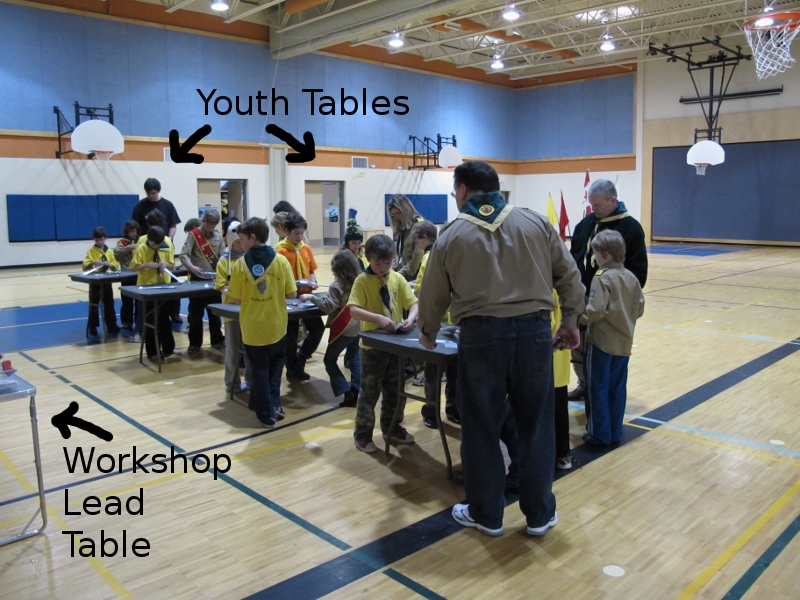
 Arrange the tables so that everybody can see the person demonstrating each step. At the right you can see a couple of ways of setting up in a gym. In the classroom it’s good to join childrens’ desks together so they can share glue, scissors and see each other’s work.
Classroom configuration: Prepare workspace for building. The common collapsible tables found in most venues are very comfortable with as many as six youth per table. This also makes it easy to assign one adult per table.
Start with a flying demonstration. (A leader should hand out materials during demonstration). One or two flights is enough. It’s important that youth see what their finished project will look like and how well it can fly. This is also an opportunity to show them how to pick a Squirrel up by the nose piece. Show the launch technique which involves two steps. Release propeller, wait for it to spool up, then a gentle launch.
Each participant should bring a small box. One small box with one edge at least 12.5″ for carrying their Squirrel.
One or two people should be in charge of taking pictures. This makes the occasion more memorable. Almost every adult I meet talks about model airplane memories from childhood. Having pictures makes it all the more fun. Don’t forget you can also submit pictures to your association magazines and newsletters.
One person should lead the workshop.
Method of demonstration. At the beginning, they will instruct youth to listen to each step completely before beginning to make sure they understand it. The workshop leader will say “go” or “woof” when they are finished demonstrating the assembly step It takes a few minutes for youth to get over the temptation of starting the step before the instructions are finished. Start using this technique with showing how to get the parts out of the package and organized them on the table. Be sure to reinforce the technique.
Repeat this cycle until all gluing is done and make sure all the wings are lying flat and the body sticks are on a ledge so everything can dry straight.
Individual work space organization. If the workspace is organized as described in the video (right) it will go much smoother with less chance of breaking things before the project is complete.
 Flag system. You can make flags out of some putty, paper and wooden sticks. You can use any object that can be flipped over to indicate that a step is finished. You can have a flag for each table or a flag for every participant. When all the flags are raised, the leader starts the new step. As long as the flags are not raised, helpers will circulate to help the slower ones catch up.
It is important that the helpers at each table keep youth on track and focused. The workshop leader cannot lead the steps, provide support and worry about focus.
While glue is drying the children can tie their elastic using a reef or square knot.
While glue is drying, a brief flying demonstration. Review the techniques of handling. Include how to handle the wing and motor stick when they are not attached and how to handle them the wing is mounted. Launch a model with the wing incorrectly adjusted and have the children call out “forward” or “backward” to make sure they understand trimming.
By the time the demonstration is over, the planes should be ready for flying.
Walk through the step of mounting the wing, elastic motor and propeller.
Have the children line up so that there is a line-up for each flying coach.
The children will wind their propeller about 200 times and give it a light toss. The adult will give them feedback and they go get their plane and return to the line. After a child is comfortable with winding and launching, then they can go to the other side of the gym for some free flying time.
There should be one table with an adult helping with repairs. When a plane is repaired it stays at the repair table until the glue is dry.
Happy flying!


1 thought on “Class Room and School Projects”
Comments are closed.