
Squirrel is a great choice as a model aviation activity.
The design is popular in many countries (USA, Australia, England, New Zealand and Canada to name a few) We look forward to receiving your flying reports, pictures and video!
You can order kits or prepare materials from your local hobby stores and craft suppliers. Kits do not require tools. Just glue and scissors.
It’s a fun and constructive activity that helps refine motor skills, draws attention to nature (weather and winds) and gives life long memories.

Squirrel was featured in Scouts Canada Magazine in January/February 2010 (see thumbnail at the left). They did a full two pages with pictures and information.
 Here are some Scout leaders in Brisbane, Australia (right). They have practices making the planes and now they are ready to show the youth what they have learned! Having some of the leaders make the planes ahead of time is a common practice. It’s fun and helps understand the steps.
Pictured below is Darcy Whyte (Squirrel inventor) as a Cub-Scout with his Dad who was a Cub and Scout leader. These pictures were taken in Sagehill, Saskatchewan around 1972-1973.


 Squirrel model planes are a great experience for leaders and youth! Have a look at the smiles on Suzan Meuhlherr and Al Griffin at Scouts Canada in Ottawa (right)!
Guide on how to run a model airplane workshop
You can also book Darcy and friends to help with workshops and flying. Please don’t hesitate to contact us to help find someone in your area to help with your workshop. You can also use the Squirrel Handbook which you can print and have the steps in great detail.
Step 1: Obtain enough kits for your group. You’ll need one per youth and one per adult. Kits can be purchased or you may follow directions on the make it page if you’d like to make yours from scratch.
Kits include everything except glue and scissors. No other tools will be required (unlike other high performance model airplanes).
 Aleene’s Tacky glue (right) is the best choice. You will need one bottle which will last many workshops. Other types of white glue and carpenter glue will work but the dry time is much longer. Generic glue sticks and scissors are required too. You need about one glue stick and scissors for every two youth.
You will also want the youth to bring boxes to carry their creations home. A box with one edge more than 12 1/2 inches (32cm). You can often carry several planes in one box.
Step 2: The fun begins! All the adults should build their kit on their own following the video directions on the make it page and contacting Darcy with questions. The steps are in a specific order for specific purposes. The downloadable instruction sheet lists the instructions in order as well.

 Be sure to take pictures of everybody with their Squirrel and share it with everyone as it makes the occasion much more memorable. Contact Darcy with questions, comments and feedback. This helps us make revisions to the video and printed instructions.
The Workshop
If you would like to lead a workshop or have some students lead the workshop here are some suggestions to make it easier. It can be done in two sessions of 1.5h or more. One for building and one for flying. Also a session of 2.5-3h works but younger children may find it challenging.
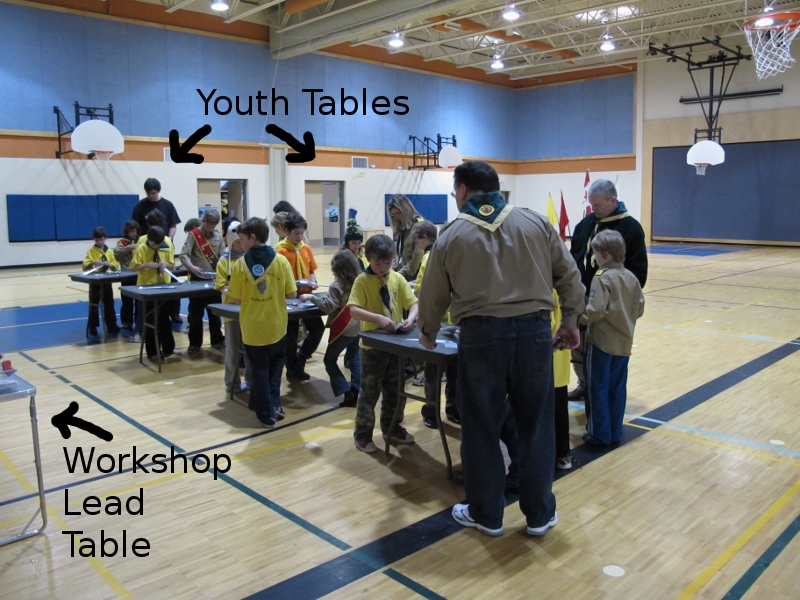
 10) Arrange the tables so that everybody can see the person demonstrating each step. At the right you can see a couple of ways of setting up in a gym. In the classroom it’s good to join childrens’ desks together so they can share glue, scissors and see each other’s work.
Classroom configuration: Prepare workspace for building. The common collapsable tables found in most venues are very comfortable with as many as six youth per table. This also makes it easy to assign one adult per table.
Start with a flying demonstration. (A leader should hand out materials during demonstration). One or two flights is enough. It’s important that youth see what their finished project will look like and how well it can fly. This is also an opportunity to show them how to pick a Squirrel up by the nose piece. Show the launch technique which involves two steps. Release propeller, wait for it to spool up, then a gentle launch.
Each participant should bring a small box. One small box with one edge at least 12.5″ for carrying their Squirrel.
One or two people should be in charge of taking pictures. This makes the occasion more memorable. Almost every adult I meet talks about model airplane memories from childhood. Having pictures makes it all the more fun. Don’t forget you can also submit pictures to your association magazines and newsletters.
One person should lead the workshop.
Method of demonstration. At the beginning, they will instruct youth to listen to each step completely before beginning to make sure they understand it. The workshop leader will say “go” or “woof” when they are finished demonstrating the assembly step It takes a few minutes for youth to get over the temptation of starting the step before the instructions are finished. Start using this technique with showing how to get the parts out of the package and organized them on the table. Be sure to reinforce the technique.
Repeat this cycle until all gluing is done and make sure all the wings are lying flat and the body sticks are on a ledge so everything can dry straight.
It is important that the helpers at each table keep youth on track and focused. The workshop leader cannot lead the steps, provide support and worry about focus.
While glue is drying the children can tie their elastic using a reef or square knot.
While glue is drying, a brief flying demonstration. Review the techniques of handling. Include how to handle the wing and motor stick when they are not attached and how to handle them the wing is mounted. Launch a model with the wing incorrectly adjusted and have the children call out “forward” or “backward” to make sure they understand trimming.
By the time the demonstration is over, the planes should be ready for flying.
Walk through the step of mounting the wing, elastic motor and propeller.
Have the children line up so that there is a line-up for each flying coach.
The children will wind their propeller about 200 times and give it a light toss. The adult will give them feedback and they go get their plane and return to the line. After a child is comfortable with winding and launching, then they can go to the other side of the gym for some free flying time.
There should be one table with an adult helping with repairs. When a plane is repaired it stays at the repair table until the glue is dry.
Happy flying!
Aviation Troop Specialty Badge

 Cubs and Scouts are now building Squirrels as part of their various merit badges. Here are some pictures I got from the Scouts Canada Web site from an article written by Christopher Singleton who is a model airplane expert and advocate.

